Wednesday, December 16, 2015

Convenience

How to say it: the 65.5 inch average female from the previous post might belong to a particular affluent demographic. Certainly the large influx of Latino women into the US population is shorter than that. Why mention it? Actually the issue is of some importance to the clothing industry. No one dresses all women, but individual brands have to know their clientèle.

Although, increasingly, the move within fashion is toward Fall-Where-They-May clothes, not altogether an aesthetic, but also a convenience for the industry.

And then there is the age question. Who cares? Below, a picture I took for my December 8 birthday. I am not a young woman, but I do not particularly signal age with my clothes. I dress for comfort although, to this day, I feel dressed down if I am not in a proper dress. And I rarely wore pants to the office. To put it succinctly, one dresses more modestly with age.


Tuesday, December 15, 2015

Pancakes

Made six Aunt Jemima pancakes yesterday and froze five. Each will make a meal,after
a turn in the toaster and the addition of various toppings. Used a lot of oil for frying, and mixed with an electric mixer (no lumps). Pretty happy with the results.
Kh


Normal Example

A function that uses x as the independent variable and one that uses e^x are not
the same thing.That is because e itself is a function of sorts, the product of (1 + 1/n)^n
 for a very large n. It is an irrational number (the decimal roll-out has no end, and
a transcendent number (like pi) with no geometrically stable analog ( any sufficiently
large n will generate a good chunk of it). It isparticularly useful just for this reason:
one can use it to the precision that one needs.

In the case of the normal density function, what does x mean. The expression in e
will take on different values as one moves on the x-axis, and that is the independent
variable. But taking a concrete example, as below, it is where one finds oneself on
the x-axis, and thus with respect to standard variation, that is informative.

Stanford gives the Example of the average height of women in the US. It can be
assumed to be normally distributed around a mean. The mean is 65.5 inches and
the standard deviation is at 2.5 inches plus or minus. That is to say, a majority of
women are between 63 and 68 inches.

One can create a graph with the more elaborate formula, specifying sigma at plus
or minus 2.5. And indeed, 68% of the area will show up between these values.


(Wolfram on-line definite integration calculator)


http://statweb.stanford.edu/~naras/jsm/NormalDensity/NormalDensity.html

Monday, December 14, 2015

GNormal

The fact is well-known: the below formula and accompanying curve represent, in mathematics, the random distribution of probabilities or, in statistics, that of errors. All very nice, but what does that mean.

I cannot imagine a path of reasoning that would lead me to the median x at approximately 40%. With either an even or odd number of events, one is always dealing with 50-50 odds. Where does this number come from.

Looking at the simplest version of the formula - with the median at 0, and the standard deviation at 1(standard normal) - the coefficient of the function yields this .4. In effect, the probability of hitting the median position as such is 0. Every position is to be considered as a between of two others. In that world, one approximates the .4 at every turn. But why .4?

The quick answer: Pythagoras. the distance between two points is a square root, here of the full circle at 2 pi.The e part of the formula flips a classic exponential curve into a bell shape. (e is in fact necessary to avoid an asymptote at x=0). This function is a density representation. We half it and show positive and negative x.


Sunday, December 13, 2015

Loving e


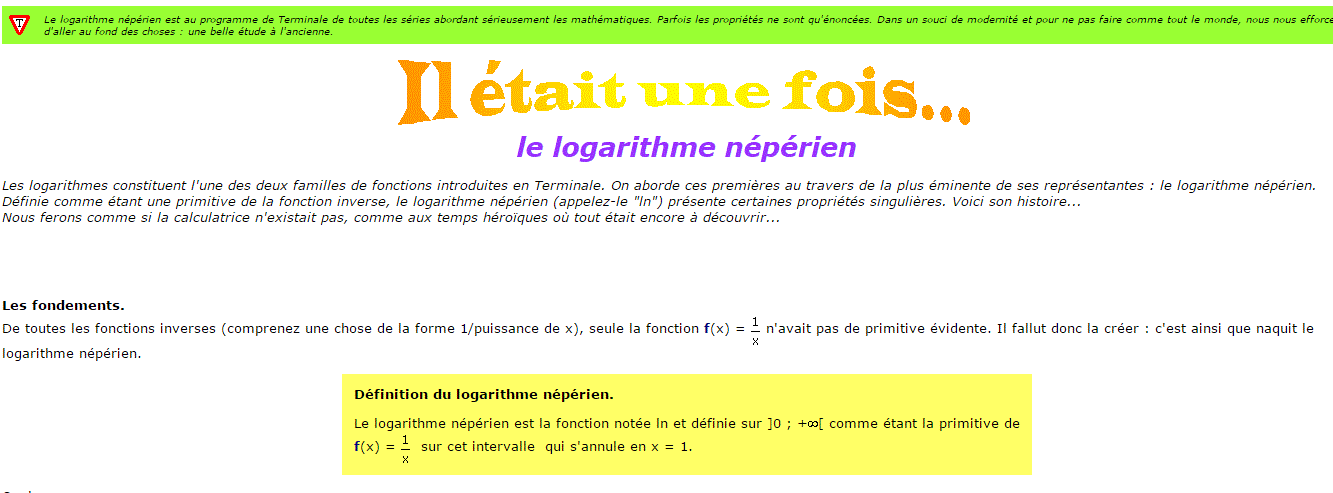
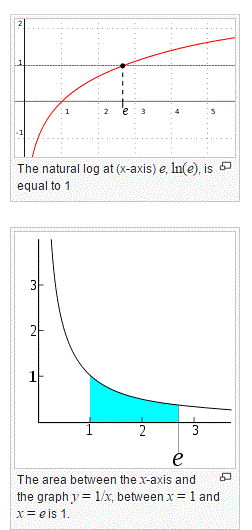
I think I have finally come to terms with e, the base for the natural logarithm. It is a very useful thing. Looking through various help in math sites, I came across the below entry into the matter, to the effect that - historically - the invention of e became necessary in the on-going work in calculus as one tried to define integrations as the opposite of derivations ie that one could find the distance covered by a moving element as a non-constant speed by adding the little bits ie integration. Newton (1642-1726) does come before Euler (1707-1783)!

In effect, the fundamental theorem of calculus does posit that derivation and integration are opposites. The notion of primitive is a delicate one. one has to be aware of the difference between a free variable (for which one could sub a constant), a bound variable, and a silent one (place-holder), distinctions which came recently in mathematics.

If logarithms made calculations easy for times  before the invention of the calculator, one can still appreciate it today as the bridge to those darn values that don't turn out evenly in calculation. Below,
e to power .25 does come back to itself if the value is multiplied by itself three times!!


Thursday, December 10, 2015

Wednesday, December 9, 2015

CouCode

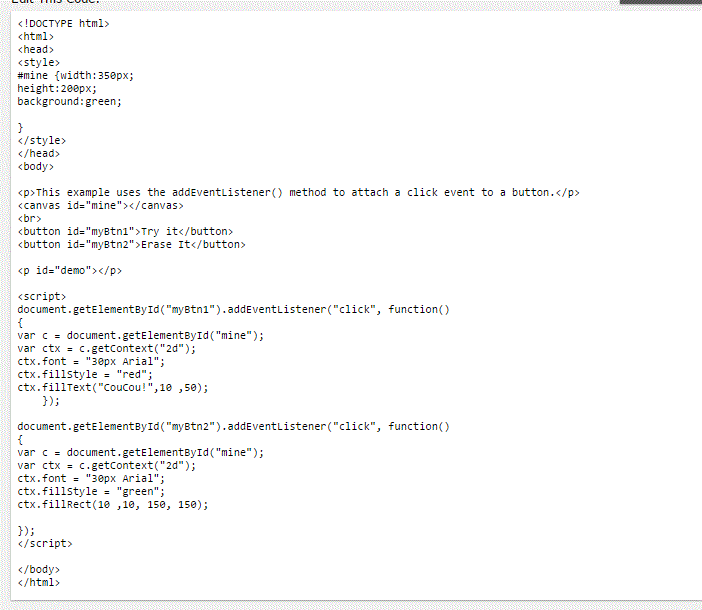
Below is the code I am currently using on the below Cou output. The erase function is
more of a clever patch than proper code. Onward!