
Tuesday, June 30, 2020

Monday, June 29, 2020
P_Turn
One of the standard graphics achievements in animation is
a book with turning pages. There are many fine examples on
YouTube; I would guess,using tools from the Adobe suite.
But what can be done on synfig? Below, simply using the mirror tool.
Going to need to tinker with this one...
a book with turning pages. There are many fine examples on
YouTube; I would guess,using tools from the Adobe suite.
But what can be done on synfig? Below, simply using the mirror tool.
Going to need to tinker with this one...
EELV
There was a high degree of abstentions Sunday - 58,4% - for the
second and decisive round of municipal elections in France. This
proved an opportunity for the election of Green candidates in a number
of important cities, including Lyon and Strasbourg. In Paris, Anne Hidalgo
of the Socialists swept through again in a coalition with the Left and the
Greens.
EELV is an electoral coalition of Greens that run in local and European elections.
https://www.liberation.fr/apps/2020/06/carte-interactive-municipales/
Congratulations to all! 🐱🐉
second and decisive round of municipal elections in France. This
proved an opportunity for the election of Green candidates in a number
of important cities, including Lyon and Strasbourg. In Paris, Anne Hidalgo
of the Socialists swept through again in a coalition with the Left and the
Greens.
EELV is an electoral coalition of Greens that run in local and European elections.
https://www.liberation.fr/apps/2020/06/carte-interactive-municipales/
Congratulations to all! 🐱🐉
Sunday, June 28, 2020
The Illness
Diabetes is replacing obesity as the illness to watch for...
* * *
On a cheerier note, been reading up on various terms currently popular
in philosophical discourse.
https://www.lefigaro.fr/langue-francaise/quiz-francais/aurez-vous-un-sans-faute-a-ce-test-sur-le-vocabulaire-de-la-philosophie-20200627
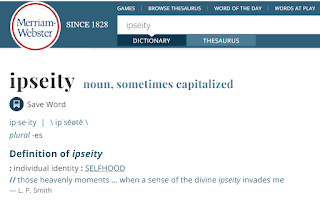
Below, looking for ipsity (ipseity).
Article: Ipsity in l'Encyclopédie philosophique.fr
author: Jérome Dôkic, EHESS
translation: GooleTransalte/doxa-louise
Introduction
The etymology of the word "ipseity" suggests the reference to a thing considered as such, or in itself, but contemporary philosophy usually reserves the use for the human person. In this regard, the notion of ipseity is transversal, and concerns several fields of philosophy, including metaphysics, philosophy of mind and philosophy of language. On the metaphysical level, the question concerns personal identity, or what makes that a person is or remains the same, at a given time or over time. One may wonder, for example, whether personal identity differs from the identity of other genera or species of entity, animated or not. For the philosophy of the mind, ipseity refers to the psychological relationship, supposedly privileged, that a person maintains with regard to himself. The question of selfhood is then that of self-awareness, or the various forms in which a person represents or experiences himself. As for the philosophy of language, it uses the notion of ipseity in particular to designate the reflexive forms that language authorizes or imposes, for example the difference that there may be between the formula "Marie saw her reflection in the mirror" and the formula "Maris saw herself in the mirror" which, unlike the first formula, implies that Mary recognized herself in the mirror.
As often happens in philosophy, each area has claimed its theoretical and methodological priority over the other areas. Some metaphysicians consider that the question of personal identity is first in the order of explanation, and that self-awareness can only be understood from a theory independent of what makes a person be or remain identical to itself. On the contrary, a philosopher of the mind can argue that the sense of selfhood must be the starting point for an analysis of selfhood, and that metaphysical questions are secondary, or dependent on psychological questions. For example, John Locke suggested that awareness a subject has of a part of his body "from within" (as a part of itself) is that it is a part of himself (2002, Book II, Ch. 27, Section II): self-awareness determines the ontology of the self. More recently in the history of philosophy, philosophers of language, often inspired by Ludwig Wittgenstein, have denounced the puzzles related to selfhood as illusions of language (or "grammatical" illusions), and considered that a careful analysis of the use of certain verbs and pronouns could be enough to allay most of the philosophical concerns linked to personal identity or self-awareness.
In the history of philosophy, the question of self-awareness has been associated with the knowledge of what we are, that is to say the type of entity to which we belong. This is how René Descartes allowed himself to draw from Cogito , conceived as the quintessential form of self-awareness ("I think, therefore I am"), the conclusion that the subject is not identical to any material body, not even his own (cf. for example Descartes' answers to Pierre Gassendi in the Responses to the fifth objections which follow the Metaphysical Meditations ). Conversely, in the Critique of pure reason, Emmanuel Kant will seek to radically dissociate self-awareness from knowledge of what we really are, by concluding that the nature of the self is unknowable (cf. B158). The relationship between selfhood as self-awareness and knowledge of our own nature is a notoriously complex subject. Today, we cannot approach it without a substantial conception of selfhood and the articulation between the three levels of analysis (linguistic, conceptual and perceptual) which have just been distinguished.
...
* * *
Published on 7/21/2017 | Le Point.fr
author: Sophie-Jahn Arrien, Laval University
translation: Google Translate/doxa-louise
Paul Ricœur (1913-2005) analyzes in many of his texts the great detour that the subject must undertake to return to itself. With this approach, a subject is brought to light which represents more a point of arrival for the philosophical effort than its point of departure. But who is the subject if it is not a purely formal truth? Who is he who finds himself by understanding and interpreting himself? Who am I, that I who says "I"?
To this question, we respond spontaneously by highlighting our character traits, our ways of being, in short, what remains fixed and identifies us as being the same person despite many changes. This form of identity has its limits. Because, strictly speaking, the permanence in time of what I am does not allow us to answer the question "who am I?" ", but rather" what am I? " Ricœur, to counter this shift, proposes to distinguish two types of identity: the first in the sense of idem or "sameness" (idem means "the same" in Latin), and the other rooted in ipse or of oneself (one will then speak of “ipseity”). The same identity applies to any object that remains in time. But if the subject does not simply exist like a chair or a stone, its identity cannot be reduced to that sameness. Rather, it refers to the dimension of selfhood which manifests itself concretely by the voluntary maintenance of self in front of others, by the way in which a person behaves such that "others can count on him". That which illustrates for Ricœur the emblematic figure of the promise in which I first commit who I am and not what I am (it is precisely beyond what I am today that I commit to keep my word).
The two ends of a chain
Ipsity does not, however, substitute for the sameness of the subject, but completes it. And this is where narrative identity comes in, that is to say that which deploys the dialectical relation uniting the poles of the idem and the ipse. This notion, which appears for the first time in Ricœur in the conclusion of Temps et récit(Seuil, 1983-1985), is based on the idea that each individual appropriates, or even constitutes himself, in a constantly renewed narrative of himself. It is not an objective story, but one that, as a writer and reader of my own life, "I" tell about myself. Personal identity is thus formed through the narratives it produces and those it continuously integrates. By doing so, far from freezing in a hard core, the “I” is transformed through its own stories but also through those which are transmitted by tradition or literature which are grafted onto it, never ceasing to restructure the whole of personal history.
"By depictins as a narrative the aim of real life, it gives it the recognizable features of characters loved or respected," writes Ricœur in Soi-même comme autre (Seuil, 1990). The narrative identity brings the two ends of the chain together: the permanence of character over time and the subsistence”. But because it allows several stories as well as their permanent restructuring, it is therefore never perfectly finalized, and because of this, it enriches the ordinary understanding of a person thus conceived of as a character engaged in a narrative struggle against the scattering of lived experiences.
Starting from the notion of ipseity, Ricœur thus leads us to a flexible and dynamic iconcept of dentity which immunizes against the danger of a return, even indirect, towards a "strong" self understood as a hard core. Often used by literary studies, Ricœur's analysis also allows dialogue with political philosophy, in particular that of the Canadian philosopher Charles Taylor who recognizes the interpretative and historical horizon within which the "self" takes source.

* * *
On a cheerier note, been reading up on various terms currently popular
in philosophical discourse.
https://www.lefigaro.fr/langue-francaise/quiz-francais/aurez-vous-un-sans-faute-a-ce-test-sur-le-vocabulaire-de-la-philosophie-20200627
Below, looking for ipsity (ipseity).
Article: Ipsity in l'Encyclopédie philosophique.fr
author: Jérome Dôkic, EHESS
translation: GooleTransalte/doxa-louise
Introduction
The etymology of the word "ipseity" suggests the reference to a thing considered as such, or in itself, but contemporary philosophy usually reserves the use for the human person. In this regard, the notion of ipseity is transversal, and concerns several fields of philosophy, including metaphysics, philosophy of mind and philosophy of language. On the metaphysical level, the question concerns personal identity, or what makes that a person is or remains the same, at a given time or over time. One may wonder, for example, whether personal identity differs from the identity of other genera or species of entity, animated or not. For the philosophy of the mind, ipseity refers to the psychological relationship, supposedly privileged, that a person maintains with regard to himself. The question of selfhood is then that of self-awareness, or the various forms in which a person represents or experiences himself. As for the philosophy of language, it uses the notion of ipseity in particular to designate the reflexive forms that language authorizes or imposes, for example the difference that there may be between the formula "Marie saw her reflection in the mirror" and the formula "Maris saw herself in the mirror" which, unlike the first formula, implies that Mary recognized herself in the mirror.
As often happens in philosophy, each area has claimed its theoretical and methodological priority over the other areas. Some metaphysicians consider that the question of personal identity is first in the order of explanation, and that self-awareness can only be understood from a theory independent of what makes a person be or remain identical to itself. On the contrary, a philosopher of the mind can argue that the sense of selfhood must be the starting point for an analysis of selfhood, and that metaphysical questions are secondary, or dependent on psychological questions. For example, John Locke suggested that awareness a subject has of a part of his body "from within" (as a part of itself) is that it is a part of himself (2002, Book II, Ch. 27, Section II): self-awareness determines the ontology of the self. More recently in the history of philosophy, philosophers of language, often inspired by Ludwig Wittgenstein, have denounced the puzzles related to selfhood as illusions of language (or "grammatical" illusions), and considered that a careful analysis of the use of certain verbs and pronouns could be enough to allay most of the philosophical concerns linked to personal identity or self-awareness.
In the history of philosophy, the question of self-awareness has been associated with the knowledge of what we are, that is to say the type of entity to which we belong. This is how René Descartes allowed himself to draw from Cogito , conceived as the quintessential form of self-awareness ("I think, therefore I am"), the conclusion that the subject is not identical to any material body, not even his own (cf. for example Descartes' answers to Pierre Gassendi in the Responses to the fifth objections which follow the Metaphysical Meditations ). Conversely, in the Critique of pure reason, Emmanuel Kant will seek to radically dissociate self-awareness from knowledge of what we really are, by concluding that the nature of the self is unknowable (cf. B158). The relationship between selfhood as self-awareness and knowledge of our own nature is a notoriously complex subject. Today, we cannot approach it without a substantial conception of selfhood and the articulation between the three levels of analysis (linguistic, conceptual and perceptual) which have just been distinguished.
...
* * *
Published on 7/21/2017 | Le Point.fr
author: Sophie-Jahn Arrien, Laval University
translation: Google Translate/doxa-louise
Ricœur and narrative identity
Who is this "I"? In "Temps et récit", the philosopher evokes an evolving entity that transforms itself through the weaving of tales. Critical analysis of a text.
Paul Ricœur (1913-2005) analyzes in many of his texts the great detour that the subject must undertake to return to itself. With this approach, a subject is brought to light which represents more a point of arrival for the philosophical effort than its point of departure. But who is the subject if it is not a purely formal truth? Who is he who finds himself by understanding and interpreting himself? Who am I, that I who says "I"?
To this question, we respond spontaneously by highlighting our character traits, our ways of being, in short, what remains fixed and identifies us as being the same person despite many changes. This form of identity has its limits. Because, strictly speaking, the permanence in time of what I am does not allow us to answer the question "who am I?" ", but rather" what am I? " Ricœur, to counter this shift, proposes to distinguish two types of identity: the first in the sense of idem or "sameness" (idem means "the same" in Latin), and the other rooted in ipse or of oneself (one will then speak of “ipseity”). The same identity applies to any object that remains in time. But if the subject does not simply exist like a chair or a stone, its identity cannot be reduced to that sameness. Rather, it refers to the dimension of selfhood which manifests itself concretely by the voluntary maintenance of self in front of others, by the way in which a person behaves such that "others can count on him". That which illustrates for Ricœur the emblematic figure of the promise in which I first commit who I am and not what I am (it is precisely beyond what I am today that I commit to keep my word).
The two ends of a chain
Ipsity does not, however, substitute for the sameness of the subject, but completes it. And this is where narrative identity comes in, that is to say that which deploys the dialectical relation uniting the poles of the idem and the ipse. This notion, which appears for the first time in Ricœur in the conclusion of Temps et récit(Seuil, 1983-1985), is based on the idea that each individual appropriates, or even constitutes himself, in a constantly renewed narrative of himself. It is not an objective story, but one that, as a writer and reader of my own life, "I" tell about myself. Personal identity is thus formed through the narratives it produces and those it continuously integrates. By doing so, far from freezing in a hard core, the “I” is transformed through its own stories but also through those which are transmitted by tradition or literature which are grafted onto it, never ceasing to restructure the whole of personal history.
"By depictins as a narrative the aim of real life, it gives it the recognizable features of characters loved or respected," writes Ricœur in Soi-même comme autre (Seuil, 1990). The narrative identity brings the two ends of the chain together: the permanence of character over time and the subsistence”. But because it allows several stories as well as their permanent restructuring, it is therefore never perfectly finalized, and because of this, it enriches the ordinary understanding of a person thus conceived of as a character engaged in a narrative struggle against the scattering of lived experiences.
Starting from the notion of ipseity, Ricœur thus leads us to a flexible and dynamic iconcept of dentity which immunizes against the danger of a return, even indirect, towards a "strong" self understood as a hard core. Often used by literary studies, Ricœur's analysis also allows dialogue with political philosophy, in particular that of the Canadian philosopher Charles Taylor who recognizes the interpretative and historical horizon within which the "self" takes source.
* * *


Saturday, June 27, 2020
Milky Way
An AFP photographer caught images of the Milky Way using
a long exposure. From Syria, on a moonless night, a
view of it remains a rare phenomenon.

https://www.journaldemontreal.com/2020/06/27/en-images-la-voie-lactee-brille-au-dessus-des-ruines-dariha-en-syrie
a long exposure. From Syria, on a moonless night, a
view of it remains a rare phenomenon.

https://www.journaldemontreal.com/2020/06/27/en-images-la-voie-lactee-brille-au-dessus-des-ruines-dariha-en-syrie
Friday, June 26, 2020
Statues
source: Liberation, Check News June 26, 2020
author: Jacques Pezet
translation: GoogleTranslate/doxa-louise
Hello,
In an interview published this June 24, 2020 in Le Point , the founder of Puy du Fou (Theme Park) and right-wing essayist Philippe de Villiers opposes the downing of statues in France, the wish for which is currently expressed by anti-racist activists for links to slavery and colonial history. He states :
"I leave that to the spiritual sons of Robespierre. The pretension to the removal of statues responds to a dangerous escalation that begins with individual whim, sometimes based on an understandable intuition, but which most often ends in the rewriting of history, thanks to a revolutionary mechanism that goes well beyond public epigraphy. The destroyers within the great expiatory movement know very well what they are doing. They seek to break our collective imagination in order to excite one the other in a memory competition in order to separate the "absolute culprits" and the "ontological victims". It amounts to neither more nor less than to perpetrate a "memory-cide" and initiate a process of penitential submission. "
However, as some internet users have noticed, Philippe de Villiers has not always been against the downing of statues. On June 30, 1989, then Member of Parliament for Vendée, he asked in the program Apostrophes that the occasion of the celebrations of the bicentenary of the Revolution "be seized by the President of the Republic to take down and unbolt all the criminals against humanity, whose crimes are imprescriptible: Robespierre, Marat, Saint-Just, Turreau, Carrier ”.
Descendant of the Le Jolis de Villiers family, part of the French nobility, Philippe de Villiers was one of the French politicians, often from the right or from the far right, who campaigned for those killed by revolutionary troops during the war de Vendée, from 1793 to 1796, be recognized as victims of a "Vendean genocide". Historians, like Laurent Avezou , oppose this term since the victims were not killed because of belonging to an ethnic, cultural or religious community and prefer to speak of "war crimes" .
Note that Philippe de Villiers demanded that the statues of those who have committed crimes against humanity be removed. And we will remember the statements of Emmanuel Macron (with whom De Villiers tells us he is sometimes in private discussion), who during a trip to Algiers in February 2017 (then candidate for the presidential election) claimed that French colonization had been " A crime against humanity" , and stated in November 2017, in Ouagadougou , that "the crimes of European colonization are indisputable".
cordially
Jacques Pezet
author: Jacques Pezet
translation: GoogleTranslate/doxa-louise
Did Philippe de Villiers call to remove statues in 1989?
While he claims that statue attackers wish to perpetrate "memory-cide", the Vendéen Philippe de Villiers had yet asked that several revolutionary figures, like Robespierre, be unbolted in 1989.
Hello,
In an interview published this June 24, 2020 in Le Point , the founder of Puy du Fou (Theme Park) and right-wing essayist Philippe de Villiers opposes the downing of statues in France, the wish for which is currently expressed by anti-racist activists for links to slavery and colonial history. He states :
"I leave that to the spiritual sons of Robespierre. The pretension to the removal of statues responds to a dangerous escalation that begins with individual whim, sometimes based on an understandable intuition, but which most often ends in the rewriting of history, thanks to a revolutionary mechanism that goes well beyond public epigraphy. The destroyers within the great expiatory movement know very well what they are doing. They seek to break our collective imagination in order to excite one the other in a memory competition in order to separate the "absolute culprits" and the "ontological victims". It amounts to neither more nor less than to perpetrate a "memory-cide" and initiate a process of penitential submission. "
However, as some internet users have noticed, Philippe de Villiers has not always been against the downing of statues. On June 30, 1989, then Member of Parliament for Vendée, he asked in the program Apostrophes that the occasion of the celebrations of the bicentenary of the Revolution "be seized by the President of the Republic to take down and unbolt all the criminals against humanity, whose crimes are imprescriptible: Robespierre, Marat, Saint-Just, Turreau, Carrier ”.
Descendant of the Le Jolis de Villiers family, part of the French nobility, Philippe de Villiers was one of the French politicians, often from the right or from the far right, who campaigned for those killed by revolutionary troops during the war de Vendée, from 1793 to 1796, be recognized as victims of a "Vendean genocide". Historians, like Laurent Avezou , oppose this term since the victims were not killed because of belonging to an ethnic, cultural or religious community and prefer to speak of "war crimes" .
Note that Philippe de Villiers demanded that the statues of those who have committed crimes against humanity be removed. And we will remember the statements of Emmanuel Macron (with whom De Villiers tells us he is sometimes in private discussion), who during a trip to Algiers in February 2017 (then candidate for the presidential election) claimed that French colonization had been " A crime against humanity" , and stated in November 2017, in Ouagadougou , that "the crimes of European colonization are indisputable".
cordially
Jacques Pezet
Thursday, June 25, 2020
CanadaR
Using masks with Synfig does open up some fascinating possibilities.
In the first example below, I have imported an image from the Web, and a
text which I use as a mask to 'reveal' the image underneath. (Simple to do,
setting the blend method on the text to Alpha Over on top of a colored rectangle).
So where am I? Somewhere in Canada...
In the second example, I can do the same trick. And because the star is a vector
drawing from Synfig itself, there is an invert function that clouds the star but reveals the
image. Now you know where we are (Clue: somewhere in Banff National Park)
In the first example below, I have imported an image from the Web, and a
text which I use as a mask to 'reveal' the image underneath. (Simple to do,
setting the blend method on the text to Alpha Over on top of a colored rectangle).
So where am I? Somewhere in Canada...
In the second example, I can do the same trick. And because the star is a vector
drawing from Synfig itself, there is an invert function that clouds the star but reveals the
image. Now you know where we are (Clue: somewhere in Banff National Park)
Subscribe to:
Posts (Atom)