Sunday, August 11, 2019

Stirling

The Stirling formula (18th century) is an approximation of the factorial values for large
numbers. It is built on the integral of the ln function, with bigO considerations
addedin. In effect, it becomes true with larger numbers of
instances. This is the nature of asymptotic relationships. Thus, it is used
in physics when large numbers of particles are at play.

The version of the formula typically used in applications is
(in big O notation, as )

It can also be a quick approximation for the gamma function, but only in
cases where exactness is not the primary concern.  The more precise
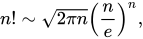
formulation:

{\displaystyle n!\sim {\sqrt {2\pi n}}\left({\frac {n}{e}}\right)^{n},}


La formule de Stirling est utilisée partout où les valeurs exactes d'une faculté sont sans importance. En particulier, lors du calcul des informations d'un message et de l' entropie d' un ensemble statistique de sous-systèmes, la formule de Stirling apporte de grandes simplifications.

Wikipedia

https://www.freecodecamp.org/news/big-o-notation-simply-explained-with-illustrations-and-video-87d5a71c0174/

                                                           *     *     *

The original formula by de Moivre:


Saturday, August 10, 2019

La Tohu

La terre était tohu-bohu, et le vent de Dieu était sur les eaux. — (Voltaire, Dictionnaire philosophique, « Genèse »)


Was given an amazing tour and musical as well as up-close trapeze artist
 performance last night. at La Falla.

A big thank you to Lyse and all those wonderful performers!


This week-end is the annual festival when the Cité des Arts du cirque
hosts the surrounding community. Multi-ethnic, wine and beer, music of
the world. Tonight is the fire-setting and main performance.

                                               *     *     *

https://tohu.ca/en/m/season/detail/2018-2019/falla-saint-michel/

Friday, August 9, 2019

Explorations


A fun utility from Desmos:


https://www.desmos.com/calculator/hmn49xqtk8

Added my own twist to it with the quadratic on negative x.
One needs to think things through, because the visuals - and
the rounded numbers - can give a wrong impression.

At power 6 ie n=6, there is still only one value for x=0


Such a utility is what it is...

                                                        *     *     *

source: Math if Fun

                                                        *     *     *
Integration and summation over a function's range
might yield similar numbers, but they are not the same.
Summation is that of specific values, while integration
measures an area.


Below, for the ln function. Integration is the upper
term from zero, minus the lower from zero.  Because
0 to 1 is in the negative in this case, beginning at 1 ups
the numbers.


The actual integral for ln(x) is x(ln(x)-1). A whole other story!!
e^x is its own integral but addition at integers and area measure
give different results there, as well.


Thursday, August 8, 2019

Two Problems

In the Cartesian orientation system, a measured orthogonal
reference plane-intersect with  center a 0 can have 3 axes: x, y and z. And
one can refer to any point in that space with the usual sequence
of numbers (a, b, c) ; for example (4, -2, 3). One is then free
to do vectorial calculations in that space. That is the usual meaning
of 3-D graphing.
In working with complex numbers, it is also possible to graph in
3-D but in this case, the resulting construct needs to show transformations
on both the real and imginary values at the same time. Frankly unreadable
for particular values, in my view, but giving a sense of the whole. Which gives
rise to peaks and valleys, color intensity, contour maps and so on. À chacun.
                                                        *     *     *
In aid of clarifying what is at stake, I propose two problems: the first Cartesian,
the second, color intensity. Answers follow!

Problem 1:
I have cut a triangular mirror and placed it ia a corner. The reference points for
the corners of the mirror are (2, 2, 2), in feet. What is the surface of the mirror.


Geogebra computes the answer. Otherwise:
Each of the sides is of length 8^.5                          by Pytagoras
A line dropped from the apex to the base will be
of length 6.007^.5 = 2.451
The triangle must be (1/2)*2.46*2.83 = 3.48


Problem 2:
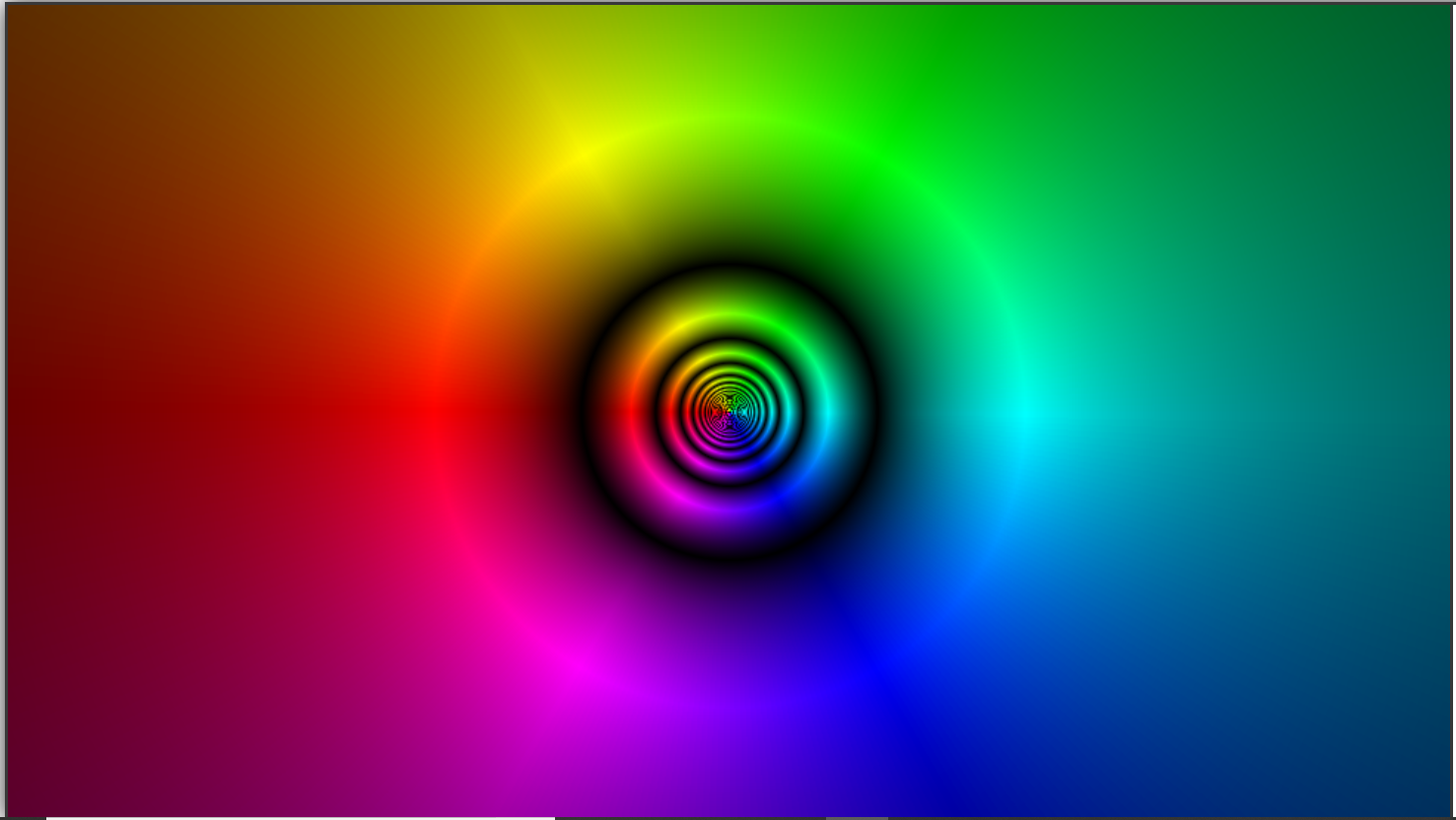
I heve generated color intensity maps of these three functions. Match the maps
with the functions.

1.                  1/z...             

2.                  gamma(z)... 

3.                 sin(z)...         

A-


B-


C-


For comparison:

With modulus .5

With modulus 2


                                                     *     *     *

Bit of a Prob

Day 2 on the integration basis for Gamma, went to the Wolfram
site, who really have a lot of info.

http://mathworld.wolfram.com/GammaFunction.html

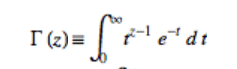
Picked up the Euler integration formula for finding a Gamma value.


The program recognizes we have asked for the gamma function
on our z. Some things are always a little maddening: we got a minus
in front. This comes from integration rules:


Now for today's Problem:

Tested the gamma values from Graph against those cited in Wikipedia:
they are ball-park.


The constant that Goole used - the Euler-Mascheroni constant - is the
long-term difference between the harmonic series and ln(x) figures.


Wednesday, August 7, 2019

Sharky

The next phase of travails to understanding the Riemann zeta
problem involves figuring how zeros are identified, although
testing to replicate was pretty cool.

It is bothersome to wonder when one knows that an indefinite
unrolling of decimals gets to be called a zero. Riemann himself
apparently found three zero thanks to a formula that uses sign changes
and the presence of primes, the Riemann-Siegel formula (Siegel
1896-1981, found it in his papers). There was an earlier approach by Euler
that compares a sum of series to results through integration, which
seems sensible.

Long story short, I need to up my level of competence yet again.

                                 *     *     *
Been learning to better appreciate the gamma function by reading
about it (in translation) on Russian Wikipedia. Because it is a
function of the complex plane, one cannot graph it properly in
2-D. In a normal Cartesian function, an x creates a y. In a complex
situation, a real and an imaginary create a real and an imaginary: too
much information...

Below, a 3-D rendering of the gamma function, with standard x and y
on the floor, and the resulting transformation on the z-axis.  The negative
integers on the x(reals) are active, but on the positive side, things happen at
.5.

One can recognize below, in olive green, the beta function which, in this form,
is a mere extension of the factorial function (calculated from an integral). It
becomes an extension of the zeta function to between 0 and 1 when multiplied
by its x position, mathematically e^ln(x). So .5*gamma(.5) yields zeta(.5).

Interestingly, gamma(.5) at 1.772 is the square root of pi. Zeta(.5) comes in at
half of that at .8862. Zeta(.5 + i) is something else again, on the complex plane.


                                                             *     *     *
                                                           

Keeping up morale, this is Shark week. The baby shark phenomena
from South Korea is viral.


Tuesday, August 6, 2019

Asian Tensions

source: Le Figaro

author: Alexis Feertchak 

translation: GoogleTranslate/doxa-louise

Updated on 06/08/2019 at 18:12; first published the 06/08/2019 at 17:52

China, Korea, Japan: Asia re-arms all-out

OVERVIEW - Against a backdrop of geopolitical rivalry between Beijing and Washington, a nuclear crisis with Pyongyang, and a historic quarrel between Seoul and Tokyo, military issues are occupying a growing space in the Asian news.


Martial declarations, military exercises, and arms purchases often testify to the geopolitical climate. The Asian continent does not escape this principle while various tensions, some local, other international, intermingle or even reinforce each other.

To the North Korean nuclear crisis is added the historical dispute now rekindled between South Korea and Japan, both allies of the United States in their rivalry with China, a new superpower, which, in turn, exerts  its influence in Taiwan, Hong Kong or the South China Sea.

● North Korea plays within limits


A few weeks before Seoul and Washington hold joint military exercises, Pyongyang proceeded on Tuesday with the fourth round of "missiles" since 25 July . In appearance two ballistic missiles that would have traveled 450 km, according to the chief of staff of South Korea. So these are still  short-range weapons , the intermediate missiles having a range of 500 km to 5500 km. Beyond this limit,  missiles are described as intercontinental and are reserved for strategic strikes planned in the context of nuclear deterrence. Pyongyang plays it safe: such testing is illegal under the sanctions voted by the UN Security Council, but do not cross the red line that would represent the firing of a missile of intermediate range (which could reach the American island of Guam in the Pacific) or an intercontinental missile (which could reach in theory all of the United-States). On the other hand, the communist regime reminds us that it can strike any point in South Korea or Japan, which was already the case before the accession of Pyongyang to nuclear power.

Less spectacular but in fact very significant, Kim Jong-un inspected last week the construction of a very particular submarine since it is of type "launcher", ie bearer of ballistic missiles fired from under the sea. Unambiguously, the communist leader shows the United States that his regime can quickly develop an underwater component to its nuclear deterrence capabiity. This is the Holy Grail which allows an atomic state to guarantee its " second strike capability " by being able to retaliate even when it has been hit by a first nuclear attack. If the political crisis between Pyongyang and Washington has calmed since 2017, however, from the point of view of proliferation, it has worsened because the North Korean regime continues its nuclear program in quantity and quality. The "denuclearization of the Korean peninsula", invoked by Trump and Kim at the Singapore summit in June 2018, has so far been fizzling.

● China and the United States stand out


On Tuesday morning, the Chinese warned  America against a deployment of intermediate-range land-based missiles in the Asia-Pacific region. "China will not sit idly by," warned a representative of the Chinese Ministry of Foreign Affairs. A reply to the statements of the new Pentagon leader, Mark Esper, who announced Saturday during a tour of Asia that he wanted the deployment of such weapons "as soon as possible."

This escalation of threaths follows the US withdrawal last week from the INF Treaty . Signed in 1987 between the United States and the USSR, it prohibited the manufacture, deployment and use of ground-to-ground missiles with a range of 500 to 5500 km. For Washington, such a withdrawal is aimed less at Russia, which it accuses of having violated the treaty, than China, which is not a signatory . With its hands free, Beijing is developing a regional "denial of access" strategy that builds on several intermediate-range ballistic missile programs. Some of them, specifically designed for naval defense, is particularly worrisome to the US Navy, whose aircraft carriers are the main means of missile launch. By developing land-based missiles,  America could try to rebalance the situation while China largely controls the South China Sea, which is at stake in many territorial disputes with coastal countries, and maintain strong pressure against Taiwan.

● South Korea and Japan revive historical tensions


In the context of the North Korean crisis and the rise of China, South Korea hinted last week that by the end of the 2020s it will acquire its first aircraft carrier , equipped with F -35B, a few months after Japan itself decided to alter its helicopter carriers so that they can accommodate the American fighter. The growing interest of the Japanese and South Koreans in the naval air force can not be explained only by the great ambitions of Beijing, which will put its second aircraft carrier into service this year and build two more modern ones. The reaction of Seoul also illustrates the standoff that opposes it to Japan. The rivalry between the two Asian powers is not new, dating back to the colonization of the Korean peninsula by imperial Japan from 1910 to 1945. Despite a normalization treaty in 1965, the two countries are regularly at odds, especially since the end of the year 2018 and more in recent weeks . While the crisis is mainly reflected in political condemnations and trade sanctions , a latent military dimension remains, recalling that the conflict is also territorial, with Japan claiming the sovereignty of the Dokdo Islands controlled by South Korea.

This quarrel can only embarrass the United States, which, beyond the arms exports that it can generate , would like to be able to offer to Beijing the image of a united front with its two allies Japanese and South Korean. Especially as Beijing, for its part, strengthens its strategic and military ties with Russia, explicitly mentioned in its latest Defense White Paper . It is not trivial that, in late July, a Russian-Chinese air patrol comprising heavy bombers resulted in a diplomatic incident and warning fire after a Russian warplane entered the  airspace of South Korea. In Asia, one hears the sound of weapons every day, weakly, but distinctly.