I'm starting to feel more comfortable around complex numbers. We
are encouraged to remember that Descartes - discussing false roots -
scoffed at 'imaginary numbers'. i for us is the imaginary constant -sqrt(-1),
but far from useless.
So the square root of a negative number may seem daunting, but in fact
one needs to consider what is happening in the larger situation. Below,
my function1 on the Cartesian plan is but 1 away from from touching the
x-axis. If I subtract 1, voilà. My function is perfectly usable.
So, someone working at the local supermarket sees on the shelve a box
of bottles of wine, and a lone bottle of the product next to it. If the label says
'contains 9', he is looking at a 3x3 container...
Next to it, a cubic case of lettuce, containing 64 but missing 4...
* * *
Couldn't help but play with Geogebra riemann function:
So, found a zero for the imaginary term...
* * *
-Putting everything on e to find the angle
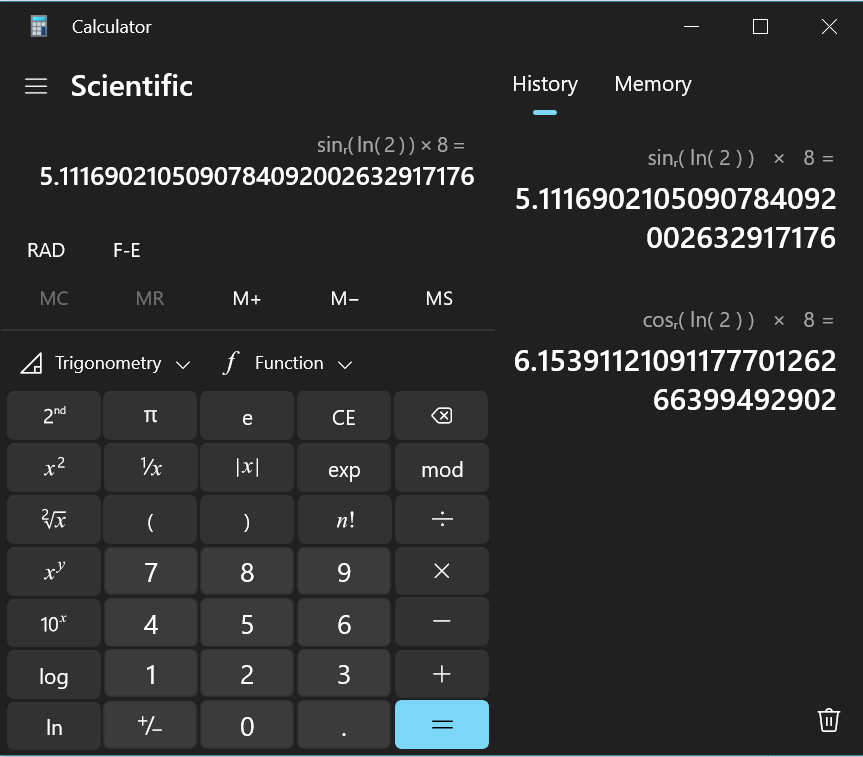
-Using sine and cos
.PNG)
.PNG)
.PNG)
.PNG)
.PNG)
.PNG)
.PNG)
.PNG)
.PNG)
.PNG)
.PNG)

.png)
.png)

.png)
.png)


.png)


.PNG)



.PNG)
.PNG)
.PNG)
.PNG)
.PNG)
.PNG)

.PNG)
.PNG)


.PNG)
.PNG)


.PNG)